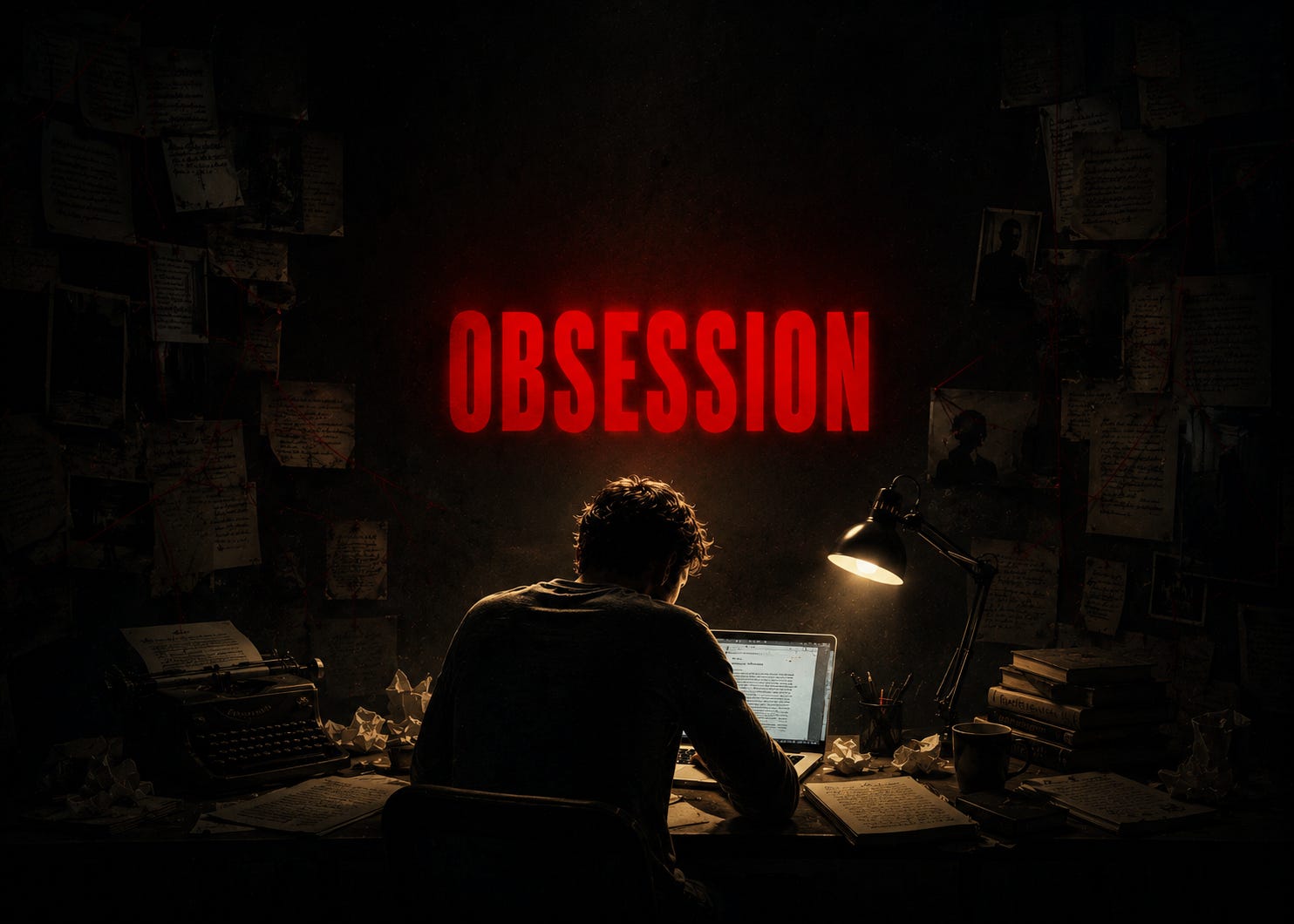
Obsession
They didn't read my words to understand the plot. They dissected my prose until my sanity was entirely naked.

That first comment on my substack article arrived on a Tuesday.
Three sentences. No name. No profile picture. Just an avatar - a single unblinking eye.
“You write about control beautifully. The way your narrators grip it so tightly. Have you noticed that the tighter they grip, the more clearly you can see what they are terrified of losing?”
I read it twice.
Told myself it was a compliment.
Deleted the notification and went back to work.
The second comment came four days later.
Longer. More specific. It referenced a paragraph from an article I had written eight months ago. Not the recent one. An old piece that almost nobody had read. It quoted the paragraph back with three words underlined.
Mine. Always. Watching.
Then below:
“You buried this in the middle of a piece about quantum entanglement. But it wasn’t about quantum entanglement, was it. It was about the specific feeling of being present in someone’s life without them knowing. You know what that feels like. The question is which side of it you’re more familiar with.”
I sat with that for a long time.
Cursor blinking.
Room quiet.
I did not reply.
Untriggered Sapien runs on cold brew and the specific unease of realizing that the most dangerous access anyone ever had to you was access you handed over willingly.
Read carefully. The clues were always there.
The third comment changed the temperature of the room.
11:47pm.
I was at my desk. The lamp on. The apartment dark around it in the specific way apartments are dark when you become aware you are the only one in them.
“You write best between 11pm and 2am. The prose gets looser after midnight. Less controlled. The sentences that give you away are always the ones you wrote when you were tired enough to stop editing yourself. I have been collecting those sentences. I have quite a few now.”
I checked the timestamps on every published piece.
Every article written after midnight was exactly as described.
Looser. Less controlled. More honest than I intended.
They had been reading more carefully than I had been writing.
I replied.
Told myself it was professional curiosity.
“You seem to know my work well. I am curious what you think you have found.”
Forty seconds.
“I know your work the way a surgeon knows a body. Not from the outside. From having been inside it long enough to understand which parts are load-bearing.”
Then:
“The question I find interesting is not what you have written. It is what you have been unable to write. The shape defined by its own absence.”
“What shape?”
Three minutes.
“The shape of someone who understands intimacy with extraordinary precision and has not allowed themselves to be fully known by another person in a very long time.”
The lamp flickered.
I told myself it was the electricity.
The conversation moved to a private channel.
I did not suggest it.
They did.
And I followed.
Which is the thing I keep returning to.
I followed.
At no point was I coerced. The pull was entirely interior — the specific gravity of being understood in real time and unable to locate the exit because some part of you does not want one.
The messages came slowly.
Deliberate.
Each one a degree closer than the last.
Not seductive in the obvious way. Seductive the way a precise question is seductive. The way being correctly diagnosed is seductive. The way it feels when someone names the thing you have been carrying without a name and you feel simultaneously the relief of being seen and the vertigo of having nowhere left to hide.
“You wrote something in March that you deleted after four paragraphs. It was the most honest thing you have ever written. I know what the fourth paragraph said.”
“That is not possible.”
“I know.”
Eleven minutes of silence.
Then a link.
A locked document. Six digits required.
“The code is the year you stopped trusting people with the full version of yourself.”
I knew the year immediately.
I typed it without hesitating.
The document opened.
My name at the top.
Not my pen name.
My actual name.
Every deleted sentence. Every abandoned paragraph. Every private piece of writing I had closed the laptop on in the middle of the night and never returned to.
All of it.
Assembled.
In the correct order.
The last page - one paragraph.
The fourth paragraph from March.
Complete.
Below it, one line:
“You have been writing toward this for three years. I have been reading toward it for the same amount of time. We arrived here together. The document was always going to end here. You were always going to read this line at this hour in this room with the lamp on and the rest of the apartment dark.”
I looked up from the screen. The lamp was on. The rest of the apartment was dark.
The identity of the commenter did not arrive as a revelation. It assembled itself. Piece by piece. While I was still trying to convince myself it was not assembling.
I went back to the beginning. The first comment. The phrase tighter they grip -not generic. The exact language from a private journal entry shared with exactly one person.
The second comment. The three underlined words pulled not from the published article but from a paragraph cut before publishing. A paragraph that existed only in the draft.
The timestamps. The deleted pieces. The knowledge of what I had written and chosen not to say.
There was only one person who had ever had access to all of it. Not a stranger. Not a reader. Someone who had been there before the writing existed.
My editor. Four years. Every draft. Every deleted paragraph. Every private piece of writing passes through an editor before it is deleted.
She had not been surveilling me. She had been reading me. More carefully than anyone had ever read anything I had written. More carefully than I had read myself.
I called her. 3:14 AM.
She picked up on the second ring. There was a heavy, groggy confusion in her voice. The sound of someone dragged out of a deep sleep.
“Hello?” she mumbled.
“You assembled it,” I said, my voice trembling with the terrifying relief of finally being caught. “The document. The fourth paragraph from March. You’ve been collecting them.”
There was a long, cold pause on the line. I heard the rustle of sheets. Her breathing shifted from sleepy to sharp, defensive.
“What are you talking about?” she asked.
“The anonymous comments,” I whispered, laughing slightly because the intimacy of it was too heavy to hold. “The unblinking eye. You told me the code was the year I stopped trusting people. You said I’ve been practicing intimacy only in my writing. You said I need to stop performing not needing anyone...”
“Shubham,” she interrupted. Her voice wasn’t quiet and precise. It was terrified. “I haven’t looked at your Substack since Friday. I’m in bed. And I have never, ever read your deleted drafts. Editors don’t have access to your local trash bin. Who told you those words?”
The air in my lungs turned to concrete.
“You... you didn’t write the document?”
“No,” she said, her voice rising in panic. “But Shubham... those lines you just quoted to me? About practicing intimacy and performing? Those aren’t from your drafts. You wrote those exact sentences in a private letter last year. The handwritten one you kept locked in your desk drawer. The one you never showed anyone.”
The silence between us didn’t have a texture anymore. It was a vacuum.
“Shubham?” she called out through the speaker. “Are you there?”
I didn’t answer.
My eyes slowly drifted away from the phone, moving across the desk, past the glowing monitor, and into the heavy, absolute darkness of the hallway behind my chair.
The document wasn’t a digital hack. It wasn’t an editor reading my files. It was someone who didn’t need a screen to read me. Someone who had been sitting in the room, watching my fingers move across the keys, reading the pages over my shoulder while I slept, and opening the physical drawers of my life with zero velocity.
A sudden, sharp notification blinked on the monitor. The private chat window refreshed. A final message from the unblinking eye:
“She doesn’t know you like I do. Look behind the curtain.”
I looked up. The lamp was on. The rest of the apartment was dark. And from the corner of the room, inside the absolute blackness of the closet, I heard the soft, distinct sound of someone gently clearing their throat. In the shadows, a long leather belt uncoiled, sliding slowly through her manicured hand. My chest tightened. I could never forget those hands - because those hands had been my singular, dark obsession during my most vulnerable moments…
The exact micro-second the monitor goes dark. Read the unedited, sensory breakdown of what happens when I finally turns around to face those manicured hands in the dark.
The contents of the locked desk drawer. Access the private, handwritten pages she transcribed by hand while watching him sleep - the thoughts that never touched a digital keyboard.
The complete, raw confession from March. The exact sentence that took three years to write, and less than sixty seconds to completely dismantle his safety.
A deep psychological dive into why the mind craves the absolute relief of being captured when it is completely exhausted by the labor of staying hidden.
The closet door is wide open. Stop running from the ending.