

The Inheritance
My father died leaving me three things: a house, his savings, and a notebook explaining why three generations of men in our family hurt the women they loved and abandoned their sons at seven

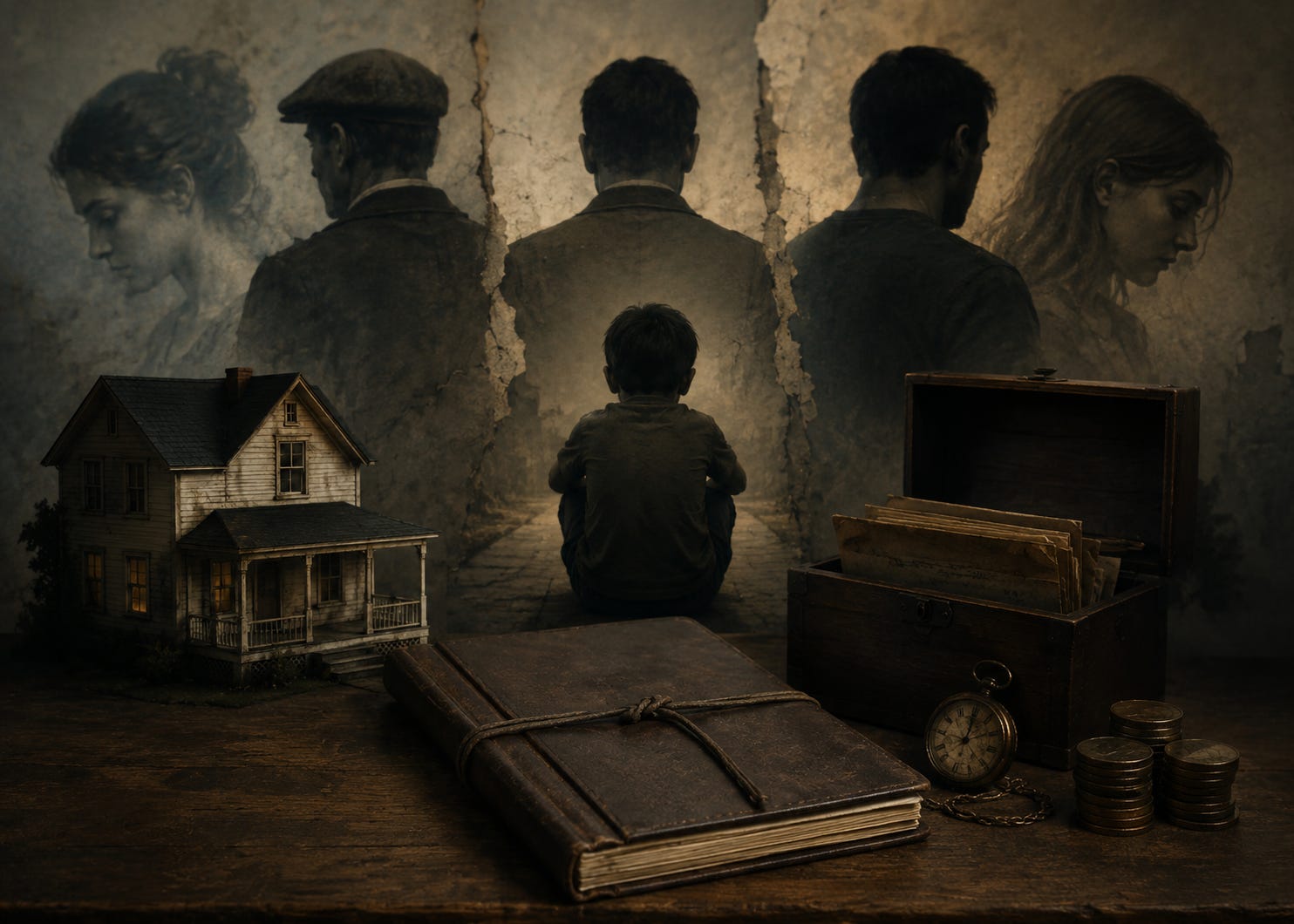
The will was clean. Too clean. House. Savings. Car. The lawyer read it like a shopping list, his voice flat and professional, as if my father’s entire existence could be reduced to three items and a signature.
Then he slid something across the mahogany table.
Brown leather notebook. Edges worn smooth from years of handling. My father’s handwriting on the cover, neat and deliberate: “For Hank. When I’m gone.”
My throat tightened.
I almost left it there. Almost walked out of that office and never looked back.
Didn’t.
Untriggered Sapien runs on cold brew and the inherited patterns you mistake for personality.
I’ve spent years unpacking what gets passed down through bloodlines (not just genetics, the other shit, the invisible programming of how we love and break and destroy quietly). If you’re tired of repeating cycles you didn’t choose, this work will show you the mechanism.
The notebook sat on my kitchen counter for three days.
Couldn’t touch it. Couldn’t open it. Couldn’t even look at it directly without feeling something cold settle in my chest.
My father had been dead for two weeks. Heart attack. Quick, they said. As if speed makes death kinder. As if brevity erases a lifetime of damage.
We weren’t close. That’s what people say when they’re being polite. The truth: we were strangers bound by biology and a shared address for fourteen years, and even that felt like too much proximity.
He left when I was seven. Disappeared. No warning. No explanation.
Came back exactly on my fourteenth birthday. Walked through the door like he’d been at the store, not gone for seven years. My mother didn’t say a word. Just stepped aside. Let him in.
Neither of them ever explained where he’d been. Neither of them acknowledged the seven-year gap. We all just... adjusted. Pretended it was normal.
But I know why he left.
I was there. I saw what happened the night before.
I was seven years old when I learned what fear looks like on my mother’s face.
It was late. Past midnight. I’d gotten up for water. Throat dry. House dark except for the hallway light.
Their bedroom door was cracked open. Just enough.
I could see them.
My mother was crying. Asking him to stop. Saying “please” in that voice that makes you feel small even when you’re not the one it’s aimed at.
He wasn’t listening. Or he was listening and it didn’t register as mattering.
His hands were on her. Not gentle. Not asking. Taking.
She was pushing him away. He was pulling her back. The bed shaking. Her voice breaking around the word “no” like it had been used too many times and worn down to nothing.
I stood there. Seven years old. Frozen.
Then I did something I’d never done before.
I yelled.
“Leave her alone.”
Voice cracking. Fists clenched so hard my nails cut crescents into my palms. Blood warm against skin.
My father stopped. Turned. Looked at me.
For a moment, something broke in his face. Like he’d just woken up from sleepwalking and realized where he was. What he’d been doing.
Then the freeze set in. That same cold detachment I’d seen a hundred times before, but different now. This time it was laced with something else.
Shame.
He got up. Walked past me without a word. Went to the guest room. Closed the door.
The next morning, he was gone.
No note. No explanation. Just gone.
My mother never spoke about it. Not once in seven years. We just pretended it was normal that a man could evaporate and return like seasons changing.
That’s the thing about dysfunction. You learn to live with it. Navigate around it. Mistake it for normalcy.
Day four, I opened the notebook.
Expected answers. Apologies, maybe. Some explanation for why he was the way he was (emotionally unavailable doesn’t begin to capture the permafrost, the way being near him felt like standing next to something extinct).
First page, dated March 1987. The morning after.
“Hank turned seven yesterday. I left this morning. Had to. The pattern is starting and I can see it now. Not just in how I look at him. In how I touched her last night.”
My stomach dropped.
“I became my father last night. Not metaphorically. Literally. I forced myself on my wife while my son slept down the hall. And when he caught me, when he yelled at me to stop, I felt nothing. Just the freeze. Just the cold recognition that I’ve become exactly what I swore I’d never be.”
The handwriting deteriorated toward the bottom of the page.
“My father left when I turned seven. The night before, I caught him doing the same thing to my mother. I yelled at him to stop. He looked at me with that same frozen expression. Left the next morning. Came back on my fourteenth birthday. Never explained. Never apologized.”
“Now I understand why.”
The notebook wasn’t a confession.
It was a blueprint.
Three generations of men who felt deeply but expressed nothing. Three generations who hurt the women they married. Three generations who abandoned their sons at seven and returned at fourteen because that’s when the pattern says you’re allowed to come back.
When your son is old enough to understand what you are.
My father documented it. His father had done the same (there was a reference to another notebook, older, pages yellowed, words faded).
They all saw it. They all tried to break it. They all became it anyway.
The entries spanned years. Attempts at connection that died in his throat. Moments where he wanted to reach for my mother and physically couldn’t. Times he watched me as a child and felt nothing but cold detachment he described as “the freeze.”
Not cruelty. Absence.
But worse than absence: the violence that came when the freeze cracked.
He wrote about work.
How every failure felt like proof he was worthless. How inadequacy at the office translated to rage at home. How my mother became the repository for every disappointment, every humiliation, every moment he felt small in the world.
“Lost the Kapoor account today. Ten months of work. Gone. Came home and she asked how my day was. The words ‘how was your day’ shouldn’t make you want to break something. But they did. I snapped at her. Called her stupid for asking. Watched her face crumble. Felt nothing. The freeze was complete.”
“My father did the same thing. Lost his job in ‘67. Came home and took it out on my mother for three years. Not hitting. Worse. Cold, calculated cruelty dressed up as disappointment.”
When I failed to make the cricket team at twelve:
“I told him he wasn’t good enough. That he’d embarrass me if he tried again. Watched his face crumble. Felt nothing. My father used those exact words on me when I failed the entrance exam. I swore I’d never say them. But they came out anyway. Like they’d been waiting in my throat my whole life.”
When my mother asked him to talk about his feelings:
“I wanted to. The words were there. But my throat closed like someone was choking me from the inside. My father used to stand outside my mother’s bedroom door the same way. Paralyzed. Unable to offer comfort even when he knew she needed it.”
When she finally stopped asking:
“Relief. That’s what I felt. Relief that I don’t have to pretend anymore. Just like my father must have felt with my mother. The relief of giving up.”
The entries about my mother cut deeper.
She wasn’t collateral damage. She was a casualty of proximity.
“She’s crying in the bedroom. I can hear her through the wall. I should go to her. Normal men go to their wives when they cry. I’m standing in the hallway and I can’t make my legs move. My father used to stand outside my mother’s door the same way. Paralyzed. The pattern is a fucking straitjacket.”
He documented every moment he failed her. Every time she reached for him and got nothing back. Every anniversary where he couldn’t say the words, couldn’t touch her the way she needed, couldn’t be anything other than a ghost sharing her bed.
“She asked me why I married her if I was going to be like this. I don’t have an answer. I loved her. I think. I don’t know what love feels like when the freeze is permanent. Maybe I just thought marriage would fix me.”
“She’s stopped trying. Ten years and she’s finally stopped. The relief is back. And the shame. The fucking shame that relief is what I feel.”
There were pages about the affairs he knew she was having. How he couldn’t even muster jealousy, just acknowledgment. Like watching weather happen.
“I don’t blame her. I’m a monument to absence. Of course she’s looking for warmth somewhere else. My father knew about my mother’s affairs too. Never said a word. Just let it happen. Like adultery was the price you paid for the freeze.”
Around page sixty, the entries shifted.
He started connecting it to his grandfather. Not just the leaving, the entire emotional architecture. The violence beneath the ice.
“I went back to the house today. My father’s house. It’s empty now, been empty since he died. Stood in his study where he used to sit and not-drink (because he’d white-knuckle through the urge rather than admit he had a problem). Found his notebook. Same brown leather. Different handwriting. Same fucking content.”
“He wrote about the night I caught him. How he’d forced himself on my mother. How he’d seen my face and felt nothing. How he left because he knew if he stayed, he’d do it again. And worse.”
“His father had one too. Three notebooks. Three generations. Three men who hurt their wives. Three men who left their sons at seven. Three men who came back at fourteen.”
“We all saw it. We all tried. We all became it anyway.”
I kept reading. Hands shaking now.
“Hank is married now. Has a son. Yohan. I’ve never met either of them. Hank doesn’t invite me. Smart. I’d just freeze at the kid like my father froze at me like his father froze at him. Or worse. I’d hurt someone. The pattern demands it.”
Last entry, dated the day before he died:
“Fourteen years is when the frustration has doubled again. When we’ve spent seven more years alone with our failures, and the weight of it has multiplied beyond bearing. But something else happens at fourteen. Our sons are old enough now to understand. To see us clearly. To judge us. To potentially become us.”
“Fourteen is when you stop being a child. When you become a witness. When the son can finally see the father for what he is: a man crushed by the weight of his own unrealized life.”
“We come back at fourteen because that’s when we can look them in the eye and see if the pattern has already started. If the freeze has begun. If they’re already learning to carry disappointment the way we did.”
“I came back on Hank’s fourteenth birthday. Stood in the doorway. Looked at him.”
“Saw my father’s eyes looking back at me. Not Hank’s eyes. My father’s. The freeze had already started in him. The weight already settling on his shoulders.”
My hands were shaking so hard I almost dropped the notebook.
“Fourteen is the age you check if the pattern took. If your son has learned to shut down. If he’s already starting to carry the weight of disappointment. If the compounding has begun.”
“The pattern is a virus. We all think awareness will save us. It won’t. I’ve been aware for forty years. Didn’t change shit. The disappointment still doubled. The weight still multiplied.”
The final line, written in handwriting that looked nothing like the rest:
“Fourteen is when you go back to see if your son will become you. And Hank... Hank was already me. I saw it in his eyes that day. The same cold distance. The same inability to feel. Yohan doesn’t stand a chance. The weight always doubles. Always finds a way to pass down.”
“The notebook has empty pages at the back. For Hank. For when he realizes what he’s already become. Just in case.”
I closed it.
Sat there in the dark for an hour. Maybe more.
My phone was on the counter. Yohan’s contact photo staring at me. Seven years old. Same age I was.
Same age my father was when his father left.
Same age his father was when his father left.
I picked up the phone. Put it down. Picked it up again.
Called my wife finally. Told her I’d been an asshole. Told her I’d been emotionally unavailable. Told her I didn’t know how to fix it but I was going to try.
Long silence.
Then: “Where is this coming from?”
“My father left me something.”
“What?”
“A roadmap. Of everything I’m doing wrong. And everyone before me did wrong. And if I don’t do something, Yohan’s going to inherit it.”
More silence.
“Hank... what did you find?”
“Proof that I’m already breaking him. Just like my father broke me. Just like his father broke him.”
I made a decision.
I’m not burying my father where he wanted.
He wanted to be cremated. Ashes scattered in the river near where he grew up. “Return to water, where we all came from” (his words, written in the notebook, poetic even in death planning).
Fuck that.
I’m burying him next to his father. And his father’s father. All three of them in a row.
The pattern lived in them. The pattern dies with them. Right there in the ground.
Not because I’m cruel. Because I’m done letting dead men dictate how the living fail.
The conversation I had with my wife that night (what she revealed about my behavior that I’d been blind to, the specific moments she saw the freeze take over, why she almost left three times)
What I discovered when I went back to confront my mother (her answer about that night, what she remembered vs. what I saw, the thing she said that changed everything)
The fourth notebook I found in my grandfather’s house (my great-grandfather’s handwriting, revealing where the pattern actually started and why)
What the therapist said when she read all three notebooks (her theory about the fourteen-year return being a grooming mechanism, how the pattern gets passed through witnessing, not genetics)
The moment I caught myself doing to Yohan exactly what my father did to me (the incident that made me realize fourteen was already too late, that seven was the intervention point)
$15/month only | Some patterns are older than you. Some damage is inherited. But continuation is a choice.
P.S. Yohan turns eight next month.
I should be relieved. He’s past seven. The pattern says I should be able to stay now.
But the notebook is still on my desk. Empty pages staring at me.
Some mornings I wake up and think about what my father wrote. About checking at fourteen. About seeing his eyes in mine.
Other mornings I think about fire. How paper burns clean. How inheritance ends when you stop handing things down.
Subscribe to learn what I’m doing differently. Because the pattern doesn’t break with awareness. It breaks with action. And I refuse to let Yohan find a brown leather notebook with his name on the cover when I’m gone.
Wow! That was so powerful to read, to try and understand. The courage it took to share is immense. I hope you have healed and understand the courage, commitment to change. Thank you for sharing and making yourself and your family history so vulnerable.💙
"“A roadmap. Of everything I’m doing wrong." Indeed. Negative role models are very instructive.